How an Indian Beer Startup Built One of the Country’s Most Recognisable Beverage Brands — and What Its Financial Crisis Reveals About Growth
Discover how Bira 91 became one of India's most recognisable beer brands through distinctive packaging, innovative branding and ambitious marketing. Explore its rapid expansion, financial challenges and the business lessons every e-commerce founder can learn about scaling sustainably.

Bira 91: How an Indian Beer Startup Built a Recognisable Brand Through Bold Branding and Product Innovation
Bira 91 became one of India's most recognisable craft beer brands by challenging the conventional image of beer. With colourful packaging, a playful monkey mascot, distinctive flavours and contemporary marketing, the company created a brand identity that stood apart from established competitors.
Founded in 2015 by entrepreneur Ankur Jain, Bira 91 grew from a relatively new entrant into a widely recognised name in India's beer market. The company attracted international investors, expanded its product portfolio and invested heavily in manufacturing and distribution.
However, its journey also took a difficult turn. Regulatory disruptions, financial losses, operational challenges and disputes with investors eventually pushed the business into a major restructuring.
The Bira 91 story offers valuable lessons for entrepreneurs about building a memorable brand, differentiating products, managing expansion and understanding why popularity does not always translate into profitability.
The Beginning: Identifying an Opportunity in India's Beer Market
Before launching Bira 91, Ankur Jain had already gained entrepreneurial experience in the United States. After studying computer science at the Illinois Institute of Technology in Chicago, he worked at Motorola and subsequently established a healthcare revenue management business.
He later returned to India and explored opportunities in the alcoholic beverage industry. His early experience included importing craft beers from international markets, giving him exposure to a category that was still developing in India.
At the time, the Indian beer market was dominated by established companies with extensive distribution networks and significant brand recognition. A new entrant needed to offer something distinctive to convince consumers to try an unfamiliar product.
Jain identified an opportunity to build a beer brand that combined international-inspired product styles with an identity designed for contemporary Indian consumers.
The company behind the brand, B9 Beverages, introduced Bira 91 in 2015. Initially, some of its beer was produced in Belgium and imported into India before the company expanded domestic manufacturing.
Rather than competing exclusively on price, Bira 91 aimed to differentiate itself through taste, packaging and brand personality.
Building a Brand That Looked Different
One of the most important decisions in Bira 91's development was its visual identity.
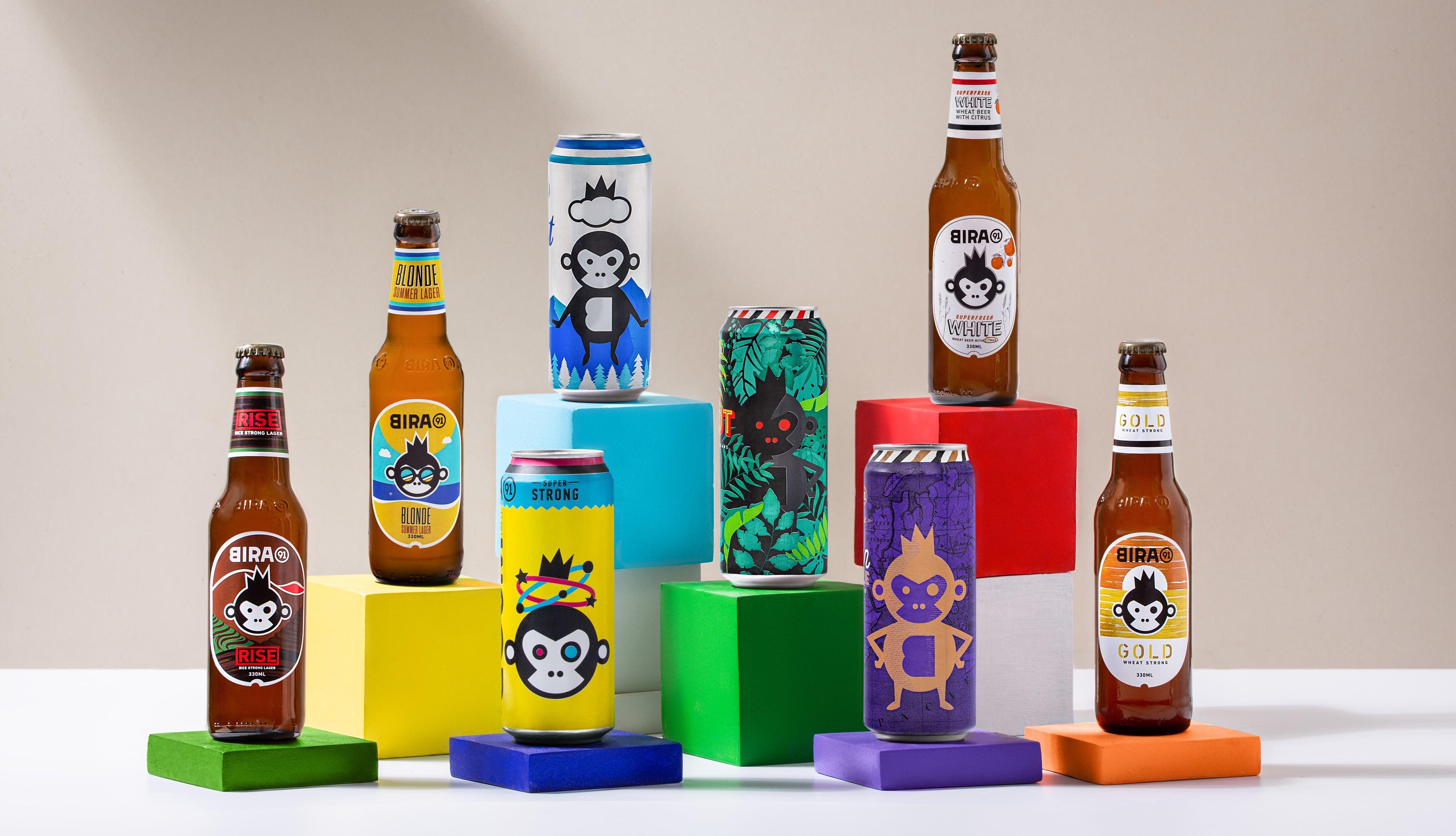
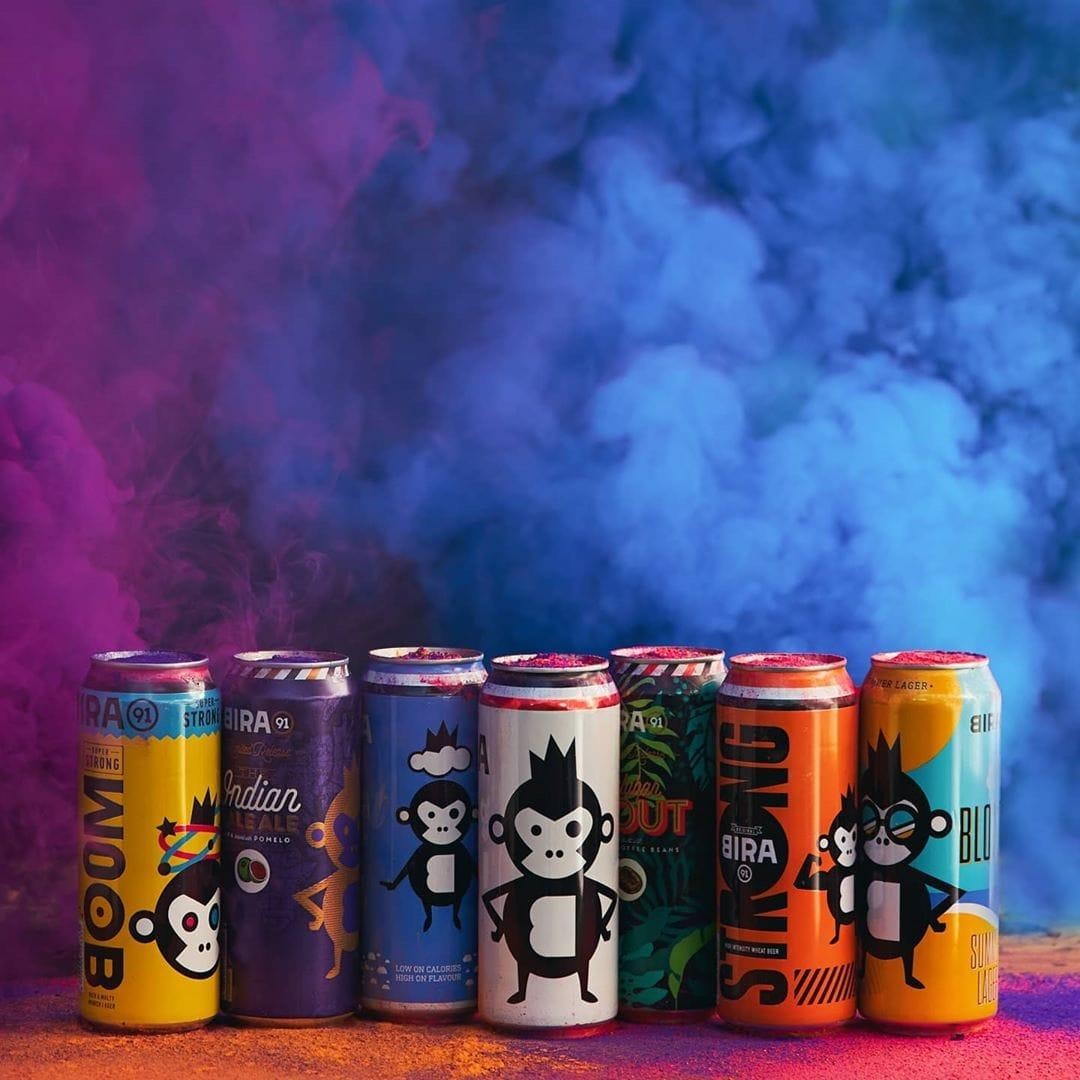
Beer packaging traditionally relies on recognisable colours, established brand symbols and familiar category conventions. Bira 91 took a more playful approach, using bright colours, distinctive typography and a memorable monkey mascot.
Its packaging helped the brand stand out on shelves and in bars, where consumers often encounter several competing products at once.
The company built its identity around a few memorable elements.
A distinctive name: Bira 91 offered a short, recognisable name. The number 91 refers to India's international telephone country code, giving the brand a connection to its home market.
A playful mascot: The monkey character gave the company a visual symbol that could be used across packaging and marketing materials.
Colourful packaging: Different products used distinctive colours and designs, helping consumers recognise individual variants while retaining a consistent overall identity.
A contemporary personality: The brand adopted a youthful, irreverent tone rather than relying exclusively on traditional beer advertising conventions.
These elements worked together to create a brand that consumers could recognise without needing to read every detail on the packaging.
For a new company competing against established players, this was an important advantage. The product had a visual identity that could generate curiosity and help it earn a place in consumers' consideration sets.
Product Innovation: Giving Consumers a Reason to Try Something New
Branding can attract attention, but a consumer product also needs to deliver an experience that encourages customers to purchase it.
Bira 91 developed a portfolio of beers aimed at different preferences. Bira 91 White became associated with wheat beer, while Bira 91 Blonde offered another option for consumers exploring the brand.
The company subsequently introduced additional variants, including Bira 91 Light, Bira 91 Strong and its India Pale Ale.
This portfolio strategy allowed the business to serve more than one consumer preference while maintaining a recognisable brand identity.
The approach also created an opportunity to introduce customers to different products under the same name. Someone who discovered the company through one variant could potentially explore another.
However, product innovation comes with costs. Each new variant can require additional manufacturing planning, packaging, inventory, distribution support and marketing.
For a growing consumer business, the challenge is to distinguish productive innovation from unnecessary complexity. Expanding a catalogue is valuable only when the additional products create enough demand and contribution to justify the resources they consume.
Bira 91's later difficulties would make this lesson particularly relevant.
Marketing Strategy: Selling a Brand Identity
Bira 91's marketing extended beyond the product itself.
The company developed a brand personality associated with contemporary urban culture, creative expression and social occasions. Its packaging and playful identity gave it a consistent foundation for advertising, partnerships and promotional campaigns.
Rather than depending entirely on traditional advertising from the beginning, the brand benefited from consumer curiosity and word-of-mouth attention. Its distinctive appearance helped people recognise and discuss the product.
As the company grew, it pursued broader brand-building activities, including sponsorships, cultural initiatives and partnerships.
The strategy illustrates an important principle of consumer marketing: people do not always choose products based only on functional characteristics. Brand identity, familiarity, social context and perceived differentiation can influence purchasing decisions.
For Bira 91, the combination of product presentation and contemporary positioning helped it establish a distinct place in a competitive market.
Nevertheless, marketing has limits. Brand awareness can encourage trial, but long-term success depends on product satisfaction, repeat purchases, availability and the economics of serving customers.
Funding and Expansion: Turning a Startup Into a Larger Business
As Bira 91 gained recognition, it attracted investment from prominent backers.
Its investors included Sequoia Capital India, later renamed Peak XV Partners, Belgian investment firm Sofina and Japanese beverage company Kirin Holdings, alongside other investors.
The company raised substantial capital over multiple funding rounds, giving it the resources to expand its operations and pursue a larger market opportunity.
This investment supported ambitions that extended beyond establishing a niche craft beer brand.
Bira 91 invested in production capacity, expanded its distribution footprint and introduced additional products. It also pursued opportunities to strengthen its presence in bars, restaurants and retail channels.
Such expansion is often necessary for a consumer goods company seeking national reach. A popular product cannot generate consistent sales if it is unavailable in the places where customers want to buy it.
However, expansion also increases the financial demands placed on a business.
Manufacturing facilities require investment. Inventory consumes working capital. Distribution networks create ongoing operational expenses. Employees, suppliers and marketing partners must be paid regardless of whether sales meet expectations.
A company can therefore grow its revenue while simultaneously increasing its financial risk.
The key is to ensure that expansion improves the underlying economics of the business rather than simply increasing its size.
The Distribution Challenge: Why Availability Matters
Bira 91's experience also demonstrates the importance of distribution in physical consumer businesses.
Unlike many digital products, beer cannot be delivered to customers without manufacturing, packaging, transportation, storage and access to appropriate retail channels.
In India, alcoholic beverages are subject to state-level excise regulations. Companies must navigate licensing, product registration and other compliance requirements across the markets in which they operate.
These requirements can make expansion more complicated than simply appointing additional distributors.
A brand may have consumer demand and sufficient production capacity but still be unable to sell its products in a market if the necessary regulatory approvals are not in place.
For a company operating across multiple states, administrative changes can therefore have significant commercial consequences.
This became a major issue in Bira 91's later history.
The Turning Point: How a Corporate Name Change Disrupted Operations
Bira 91's financial difficulties became increasingly visible after operational disruptions in 2024.
The company behind the brand, B9 Beverages, changed its registered corporate name from B9 Beverages Private Limited to B9 Beverages Limited. Although the change was administrative in nature, it created complications with licensing and product registrations across different Indian states.
Because alcohol regulation operates at the state level, the company faced the task of securing the necessary approvals under its revised legal identity.
The resulting disruption affected manufacturing and sales. Products became unavailable in some markets, while inventory and operating resources were tied up during a period when the company needed to maintain business continuity.
Contemporary reporting described the company writing off inventory worth approximately ₹80 crore as part of the disruption.
The incident demonstrated how a change involving a company's legal identity can affect an entire physical supply chain when regulatory approvals are closely tied to that identity.
It also exposed the importance of planning corporate changes around operational dependencies.
For companies in regulated industries, legal, finance, manufacturing, distribution and compliance teams need to coordinate closely. Administrative decisions that appear straightforward at the corporate level can have consequences for products, suppliers and customers.
Financial Losses and the Pressure to Raise More Capital
Bira 91's operational difficulties occurred alongside significant financial pressure.
According to reports based on its financial statements, B9 Beverages recorded revenue of approximately ₹638.5 crore in FY2024, down from approximately ₹824.3 crore in FY2023.
Its net loss widened to approximately ₹748.8 crore in FY2024, compared with approximately ₹445.4 crore in the previous financial year.
These figures illustrate the scale of the company's financial challenges. They also highlight why revenue alone is an inadequate measure of business health.
A company can generate hundreds of crores in sales and still face serious problems if its expenses, financing requirements and operating losses are too large.
Bira 91 subsequently faced concerns involving liquidity, outstanding payments, production disruptions and its ability to secure fresh investment.
The company sought additional funding to support working capital, settle obligations and stabilise operations. However, raising capital became more complicated as investors raised questions about performance, governance and the company's future direction.
Its difficulties were not simply the result of a single administrative change. Reporting also pointed to longer-running challenges involving working capital, operating costs, product expansion and management.
The broader lesson is that a disruptive event can expose weaknesses that have been building over time.
When Product Expansion Becomes Too Complicated
Bira 91's growth strategy included introducing new products and expanding its portfolio.
Innovation can be a powerful way to attract customers and create additional revenue opportunities. However, every new product also adds complexity.
A larger catalogue may require more packaging variations, separate inventory forecasts, additional production planning and greater attention from sales and marketing teams.
If demand is concentrated in a few successful products, a company may find that the rest of its portfolio consumes resources without generating sufficient returns.
Reporting in 2025 indicated that Bira 91 was considering a significant reduction in its product range as part of its restructuring efforts.
This reflects a broader business principle: sometimes, simplifying a business can be more valuable than continuing to expand it.
A company that focuses on its strongest products may be able to improve inventory management, reduce waste, concentrate marketing resources and simplify distribution.
For e-commerce businesses, the same principle applies. A catalogue containing thousands of products is not necessarily better than a carefully selected range of products that consistently sell and generate healthy margins.
The Human and Organisational Cost of Financial Distress
Bira 91's difficulties extended beyond its products and financial statements.
During 2025 and 2026, media reports described serious concerns involving delayed salaries, vendor payments, operating disruptions and disputes between the founder, investors and lenders.
These problems illustrate how financial distress can spread through a business ecosystem.
Employees depend on the company for their salaries. Suppliers depend on payments to manage their own working capital. Distributors need reliable supply to serve retailers. Retailers need products that are available consistently.
When a company experiences prolonged disruption, these relationships can weaken, making recovery more difficult.
The consequences can also affect trust. Employees, suppliers and investors may become less willing to commit additional resources when they are uncertain about the company's future.
For founders, this underlines the importance of financial controls, realistic cash-flow forecasting and transparent communication during difficult periods.
Growth is not sustainable if the business cannot reliably meet its obligations to the people and organisations that support it.
Bira 91 in 2026: A Business Undergoing Restructuring
By 2026, Bira 91's parent company had entered a major restructuring phase.
In July 2026, founder Ankur Jain stepped down from the board and executive positions as part of a settlement with lenders. The company's ownership and control arrangements changed as efforts to address its financial problems continued.
In September 2026, reporting indicated that the reconstituted board, led by lender Anicut Capital, was pursuing recapitalisation and had offered to acquire stakes held by major investors.
These developments marked a significant change from the company's earlier growth story.
Bira 91 had demonstrated that a new consumer brand could build recognition in an established market. However, its later difficulties showed that brand strength does not eliminate the need for operational stability, sound financial management and effective governance.
The company's restructuring also highlights an important distinction: a brand's past popularity and its current business condition are two separate matters.
The longer-term success of any revival effort depends on whether the company can restore reliable production, rebuild relationships with stakeholders, secure sufficient funding and establish a sustainable operating model.
What E-Commerce Founders Can Learn From Bira 91
Although Bira 91 operates in the beverage industry, its experience offers useful lessons for businesses selling clothing, beauty products, food, accessories and other consumer goods.
1. Make Your Brand Recognisable
A distinctive identity can help a business stand out in a crowded market.
Consistent colours, typography, packaging and communication make it easier for customers to recognise a product across websites, advertisements, marketplaces and physical retail locations.
However, distinctive design should support a clear product proposition rather than replace it.
2. Give Customers a Reason to Buy Again
Marketing can encourage customers to try a product, but repeat purchases depend on the overall experience.
Quality, reliability, pricing, convenience and customer service all contribute to whether a consumer returns.
Businesses should therefore measure repeat purchase rates and customer satisfaction alongside traffic and sales.
3. Expand After Establishing a Sustainable Model
Adding products, entering new markets and increasing advertising expenditure can create growth opportunities.
But each expansion decision should be supported by evidence about demand, margins, cash flow and operational capacity.
A smaller, profitable business can be stronger than a much larger business that requires continuous external funding to survive.
4. Track Profitability at the Product Level
Revenue does not reveal how much money a business actually retains.
Companies should understand the costs associated with each product, including manufacturing or purchase costs, packaging, fulfilment, marketing, returns and other variable expenses.
This helps identify which products contribute to the business and which require reconsideration.
5. Treat Operations as Part of the Customer Experience
Customers notice when products are unavailable, deliveries are delayed or quality becomes inconsistent.
Reliable manufacturing, inventory planning, supplier management and distribution are therefore not merely back-office functions. They directly influence customer satisfaction and the reputation of the brand.
6. Build Financial Controls Before Problems Appear
Cash-flow forecasting, expense monitoring, payment discipline and appropriate financial oversight become increasingly important as a business grows.
Founders should know how much working capital the business requires, how long cash remains tied up in inventory and what would happen if sales or funding fell below expectations.
Strong financial controls cannot prevent every crisis, but they can help a company identify risks earlier and respond more effectively.
Conclusion: The Difference Between Building a Brand and Building a Sustainable Business
Bira 91's journey began with a clear opportunity: create a beer brand that looked and felt different in a market dominated by established competitors.
Through distinctive packaging, product innovation, contemporary marketing and ambitious expansion, the company became one of India's most recognisable craft beer names.
Its later financial and operational difficulties revealed the limits of that success. Brand recognition could not, by itself, overcome regulatory disruption, rising financial pressure, operational weaknesses and challenges involving investors and lenders.
For entrepreneurs, the central lesson is straightforward.
A memorable brand attracts attention, a good product earns customer trust, and a well-managed business creates the foundation for long-term growth.
The strongest companies build all three together. They invest in marketing while monitoring margins, expand their product ranges while controlling complexity, and pursue growth without losing sight of cash flow and operational reliability.
Bira 91 remains a valuable business case because its story demonstrates both the power of differentiation and the importance of building a company capable of sustaining the demand its brand creates.